


This week, the Ohio Newsroom is joining NPR to tell local stories about climate solutions, as the federal government walks back environmental regulations.
A crowd of regulars were getting restless outside a small craft brewery in rural Coshocton County earlier this month.
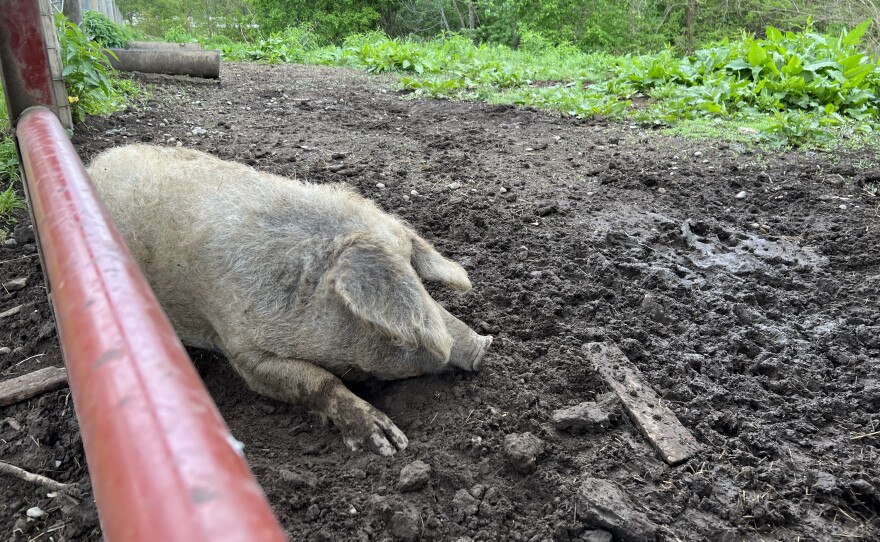
A small herd of German Mangalitsa pigs, covered in curls, jostled one another as a tractor dropped a giant mushy pile of grain into their pasture. Their anxious snorts quickly subsided as they dove snout-first into barley mash, still warm from brewing.
Wooly Pig Farm Brewery owner Kevin Ely says this is more than just mealtime for the brewery鈥檚 namesakes. It's a vital part of the business.
鈥淭he pigs help us process all of our brewery waste,鈥� Ely said.

Before a craft beer makes its way into your glass, it requires large amounts of water and energy, and it leaves behind large amounts of solid organic waste. At Wooly Pig Farm Brewery, those leftovers help feed their livestock, which they butcher and sell to help supplement their business in a closed-loop system.
Ely said very little goes to waste.
鈥淎 lot of the stuff that we do, if you were on a farm 50 years ago, 100 years ago, this is just how you鈥檇 reduce your consumption just because you needed to. It is kind of common sense,鈥� he said.
A 鈥榳in-win鈥�
鈥楽pent grain鈥� 鈥� the barley mash that the pigs devoured 鈥� is one of the . Despite its nutrient-rich potential for livestock, not every pound gets a second life, said Mary MacDonald with the Ohio Craft Brewers Association.
鈥�In some cases, it might just be like, 鈥榃ell, it's just easier to put it in the trash,鈥欌�� MacDonald said.
When that happens, there are consequences. breaks down in landfills and produces methane, a greenhouse gas that is than carbon dioxide at trapping heat in the atmosphere.


In a top craft-beer-producing state, like Ohio, the decisions of local craft breweries add up. There are upwards of here that make around a million barrels of beer each year.
Each barrel requires around 60 pounds of grain, which eventually needs to be disposed of. MacDonald said feeding it to livestock benefits everyone.

鈥淚t's a win for the farmer because they're giving a more affordable feed,鈥� she said. 鈥淎nd then it's a win for the environment because less spent grain is going to the landfill.鈥�
Across the state, urban breweries donate their spent grain to nearby farms. Some community organizations, like the Rust Belt Riders in Cleveland, even collect local beer byproducts to power community composting. All of that requires travel and coordination.
But, at Wooly Pig, the farm is just steps away from the brewhouse.
鈥淲e're trying to minimize what goes down the drain, as well as get as much of it to the animals as possible,鈥� Ely explained.
Part of a larger ethos
The swine are one sustainability measure of many at the rural brewery: Solar arrays power their electric brew kettle. They recycle heat from that kettle into the taproom. Even cleaning products are carefully conserved.
With each of these changes, Ely isn鈥檛 necessarily out to save the world. It鈥檚 a matter of business survival.
鈥淥ne of things that is often forgotten about sustainability is one of the huge byproducts of it is saving tons of money,鈥� he said.
Plus, he said it doesn鈥檛 require a ton of upfront investment. The federal government has that helped connect rural businesses, like Wooly Pig, with solar and other renewable energy projects.

But Ely says even without government help, small businesses can focus first on what they can reduce and reuse. Even low-cost changes can make a big difference 鈥� like an $18 switch on the brewery鈥檚 boiler that prevents it from running all the time.
鈥淛ust by paying attention and doing things like this, we reduced our energy consumption by 3% to 4%,鈥� he said.
He often educates other small, rural breweries on how to implement these incremental waste reductions. He says it takes trial and error. Even concocting the pig feed took a few attempts.
鈥淲e've had situations where it hasn't been blended and like鈥hey get drunk,鈥� Ely said.
The pig feed, like small sustainability efforts, can be stronger than expected.