


Ask sophomore Dubem Akunyili how he feels about living in the new South Residential Village at Case Western Reserve University and the 20-year-old student from Frederick, Md. is quick to answer.
鈥淟iving here has really shaped my experience,鈥欌�� he said. 鈥淚 really love it.鈥欌��
The 600-bed CWRU project includes two new dorms 鈥斺�痶he five-story Mary Chilton Noyes House and the six story John Sykes Fayette House, both named for alumni. They opened last year on the hillside at Murray Hill Road at Adelbert Road, where the CWRU campus edges into Cleveland鈥檚 Little Italy neighborhood.
Akunyili, who is majoring in chemical biology and economics, said that abundant study areas and social spaces in the new dorms make it easy to hang out with friends or 鈥渓ock in鈥欌�� on his studies.
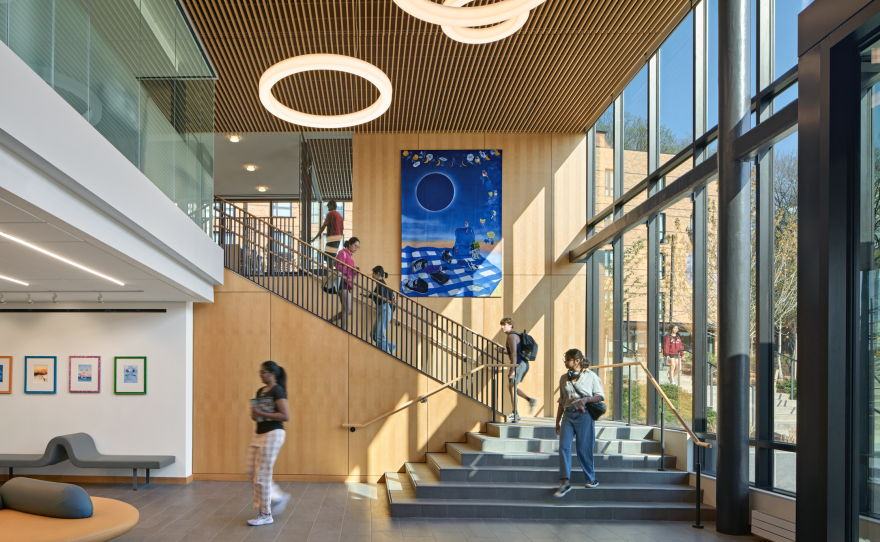
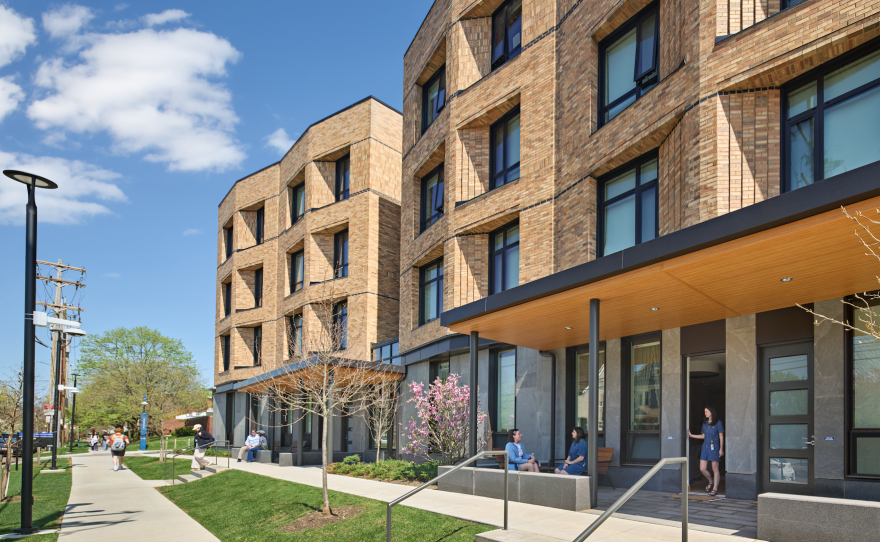
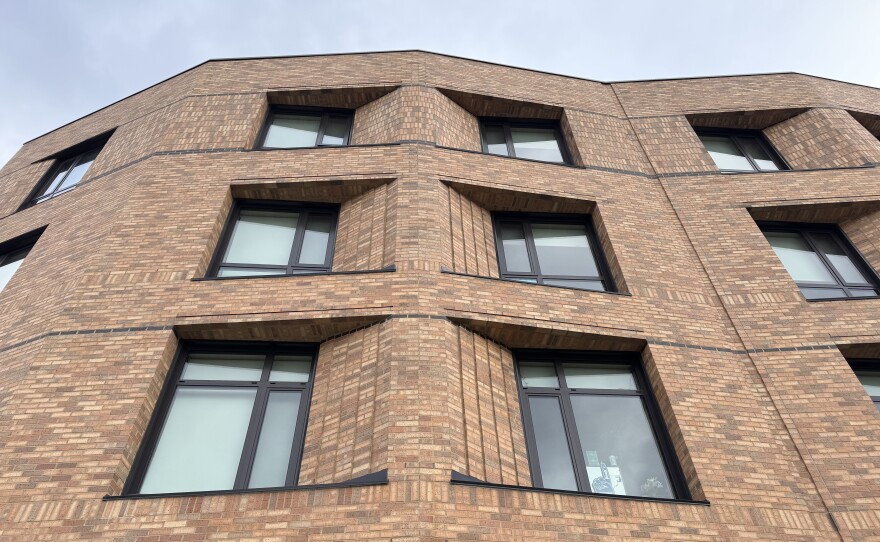
He never hears music blaring from adjacent rooms. And he loves the richly detailed facades of the new dorms, which have multi-hued brickwork in various shades of terra cotta, plus ample windows that splash interiors with daylight.

Mission accomplished
But what strikes Akunyili most about the dorms, which look mid-century modern with subtle nods to Art Deco, is that they look like they鈥檙e built to last, like the pre-Civil War landmarks in his Maryland hometown.
鈥淚 like to think of what this would be like in 100 years,鈥欌�� he said, speaking of Noyes, his dorm building. 鈥淚 see this structure as something that feels meant to stay.鈥欌��
Bingo.
The student鈥檚 comments are exactly what CWRU administrators had in mind when they conceived the South Residential Village.
鈥淥ur approach to buildings and architecture is more about permanence and longevity,鈥欌�� said Michael Bruder, the university鈥檚 in-house architect.
鈥淧eople can tell when they live in a nice building versus when they live in something less nice,鈥欌�� Bruder said. 鈥淎nd I think it does impact their student success, and their happiness and affinity for their college.鈥欌��
Designed by the Boston architecture firm of , with Sindu Meier as project manager, South Residential Village is an example of fresh, creative, Capital A architecture, which is unusual for new college dorms, or for that matter, new apartment buildings in general.
As many critics have noticed, American cities are filling up with new multi-family buildings that often look bland, boxy and generic. They also lack a sense that they鈥檙e meant to stick around longer than a few decades. It鈥檚 hard to imagine historic preservationists fighting to save them in 50 or 70 years.
The new CWRU dorms are different, for reasons that highlight trends in how college dorms are financed, designed and built, and how those factors can affect the architectural results and the surrounding city.
Competition for students
First, housing has become a key selling point in the national competition to attract the best and brightest students.
鈥淭here's no shortage of talented students, and how those students make up their mind about where to go has a lot to do with their impressions of the physical campus if they visit in person. Housing plays a big part in those calculations,鈥欌�� said Rutgers architectural historian , author of the 2019 book, 鈥淎n Architectural History of the American Dormitory.鈥欌��
As Yanni noted in a and an interview with 精东影业, some new dorms include luxurious features that would surprise Baby Boomer students who lived in cinderblock dorms with long, featureless corridors, group bathrooms and scant amenities.
She cited geared toward students at nearby Arizona State University. It has 鈥渁 two-story fitness center, a pro-tour golf simulator, an infrared sauna, an outdoor grilling area, a pool, a hot tub, cabanas, and a resort-inspired lazy river.鈥欌��
The 2019 article also described a nearly 1,400-square-foot 鈥溾�欌�� located within the then-new at the University of Akron.
Despite such frills, when it comes to architecture, new dorms can often appear generic, to judge by local examples and images published online. It鈥檚 typical, for example, to see facades with thin layers of brick or composite panels veneered in graphic patterns and slightly differentiated layers intended to ameliorate their essential blocky flatness.
Trend No. 2: Outsourcing
In addition to its architecture, the CWRU project stands out in that it was financed, designed and built under the university鈥檚 control. That differs from another major trend in campus housing: outsourcing.
Increasingly, colleges and universities are partnering with real estate companies that for building new dorms in exchange for income from student rents.
Under such arrangements, known as P3 partnerships, academic institutions can save money and get dorms built faster than they would on their own. And real estate firms, which sometimes own and manage the finished buildings, can qualify for low-interest or tax-exempt financing while earning profit.
The catch is that in P3 partnerships, academic institutions can have less control over design, which is more often managed by the development company.
CWRU considered a P3 approach but rejected it because it wanted its new dorms to last a century 鈥� and to look like they would.
鈥淧3s tend to be more short term, 30 [to] 50 years, depending on the deal that you strike with the partners,鈥欌�� said Richard Jamieson, CWRU鈥檚 vice president for campus services. 鈥淲e owned the project and own the end result,鈥欌�� he said, referring to South Residential Village
CWRU, which has rising enrollment and , a rating agency, had the housing demand and the wherewithal to self-finance its project. But that鈥檚 unusual, Yanni said.
鈥淚 don't think very many universities can take on that level of risk without a developer to work with,鈥欌�� she said.
Fitting in well
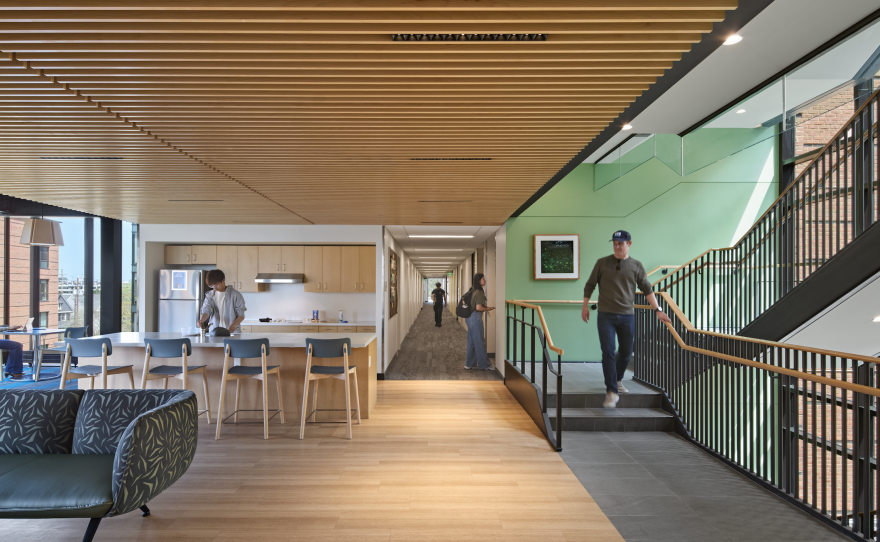
The CWRU dorms didn鈥檛 go overboard with amenities 鈥斺�痶hey lack a lazy river 鈥斺�痓ut they feel spacious and inviting, with sleek contemporary furniture and high-quality art by Cleveland-area artists. Public areas, including stairwells, communal kitchens, meeting rooms and lounges, have floor-to-ceiling windows. Some study areas have skyline views.
Rent for one bed in a double room is $14,560 a year, well above the鈥�. But鈥疌WRU鈥痮ffers lodging for several thousand dollars less in dorms near the new ones, giving students other options, Jamieson said.
Viewed from surrounding sidewalks and streets, the new dorms appear to nestle into the woodsy escarpment that separates Cleveland鈥檚 University Circle district from Cleveland Heights up the hill.
Rather than rise to their full height straight from ground level, the dorms have top floors that set back slightly from the main facades and have darker hued bricks. These design features diminish the apparent height of the buildings.
Noyes House, facing Murray Hill, has a main facade with fancy brickwork and gentle folds and curves that impart a sense of depth, heft, and lasting firmness.
Noyes also has ground-floor apartments for resident assistants with front porches that echo those on century-old wood-frame houses in Little Italy. Such touches helped the CWRU dorms virtually sail through design review sessions in the neighborhood and at the Cleveland Landmarks Commission in 2022.

The popular alternative
Of course, not every institution has the capacity or desire to undertake large dorm project entirely in-house. That鈥檚 why P3 partnerships are popular.
Local examples include the University of Akron, which in December in public-private housing partnerships, which it described as one of the biggest P3 deals of its kind in the United States.
Other examples include the 345 Flats project adjacent to Kent State University; the Euclid 117 dorms, built next to the Cleveland Institute of Art; and the 1609 Hazel dorms at the Cleveland Institute of Music, which also house CWRU students. All were projects of the Cleveland-based developer .
As with any type of building project, some P3 partnerships can run awry.
Last year, the Cleveland Institute of Music (CIM) in the Cuyahoga County Court of Common Pleas against contractors and the architect of the Hazel 1609 dorm after it bought the building in 2022 and discovered extensive leaks.
Paul Hogle, CIM鈥檚 president and CEO, declined to comment on the lawsuit, as did a representative of Cleveland-based Vocon, the building鈥檚 architect. The contractor, John G. Johnson Construction Company, told Crain鈥檚 Cleveland Business that it intended to work with CIM on a resolution. 精东影业 reached out to Bowen Construction Services, also named in the lawsuit, but did not receive a response.
Today, seams at all exterior wall panels, windows and vents on the Hazel dorm鈥檚 upper facades are covered with tape, creating a grid of white and black lines on the flat-skinned, gray building.

In defense of P3s
Hogle, who said CIM is working on a long-term fix for the building, said leaks could occur in any building, regardless of the methods involved in design, construction and financing. And he defended the logic of a P3 partnership for CIM, which badly needed new housing.
鈥淚 don't have a building design and management department,鈥欌�� he said. In a P3 partnership, 鈥測ou get to buy expertise of people that do this exclusively for a living.鈥欌��
Hogle said the dorm, which features a kitchen and laundry in each room, and which includes soundproof practice rooms for music students, helped CIM weather the COVID-19 pandemic and is still considered an important asset. Most importantly, he said that air-quality testing shows the dorm is safe.
But he acknowledged that the Hazel dorm had relatively modest aims in design.
"It certainly isn鈥檛 a disposable building, but there was nothing in our discussions ever about a building that would be architecturally significant, that would stand the test of time," he said.
The JCU approach
CWRU isn鈥檛 the only local institution that rejected the idea of a P3 partnership as a way to retain design control.
John Carroll University, which is mixed-use retail and dorm building at the edge of its University Heights campus, found it could issue bonds and build the $60 million project at lower cost without entering a P3 partnership. And it could have 鈥渢otal design control,鈥欌�� as Assistant Vice President Jeremiah Swetel put it.

To build the project, JCU engaged Independence-based DeGeronimo Cos. as the developer, while retaining ownership.
The new building, with 351 beds and roughly 28,000 square feet of retail, including a grocery, will occupy a highly visible site off Fairmount Circle, replacing a gas station and parking lot that had occupied the site for decades.
Designed by , the V-shaped, five-story building is now under construction and scheduled for students to live there beginning in the fall of 2027.
It will have a contemporary look to complement the neo-Tudor-Gothic look of the core JCU campus. And at $382 a square foot, it will cost far less than the CWRU building.
When it鈥檚 done, it will give Northeast Ohio a second new example of what universities can accomplish with dorm architecture outside of a P3 partnership.
For now, the CWRU project stands alone. It shows how architectural excellence can be rooted in numerous factors, including money, architectural talent and institutional will.
When all those forces line up in a public-facing project that helps uplift a university and the surrounding city, it should be noted because it is rare.
