


Sometimes, it takes a moment to really see a thing. Like a sign.
They’re everywhere, directing us to the exit, instructing us where to turn, informing us how tall we need to be to get on an amusement park ride.
It’s easy to let the messages glide through our awareness without even registering them.
There was a blue sign to my left during a recent trip to the returns/customer service desk at Lowe’s in Fairview Park. I glanced at it as the associate scanned the barcode of the pot I purchased the day before at the garden center.
It didn't say anything about having receipts ready. It read, “Thank you for treating our associates with respect.�
Yes, of course, I thought, in a silent dialogue with the sign. That’s how they should be treated. That's how I'd want to be treated and how I'd hope to treat them? Who needs a sign for that?
As I waited for the associate to complete her accounting, I kept reading.
“Profanity, verbal threats or violence towards our associates will not be tolerated. Thanks for helping us make Lowe’s an enjoyable place for all.�
Violence? Threats?
And that’s when I really saw the sign.
“Wow, you have to remind people to behave?� I said to the associate.
She nodded and said, “And still, every single day, there’s someone….� She gave an eyeroll, and fell silent. I knew what she meant. Someone rude, someone raising their voice, or worse, a fist.
What ever happened to ?
I first noticed signs encouraging civil behavior during doctors’ visits. Those did not startle me the way the Lowe’s sign did.
I remember the COVID-19 pandemic. Hospitals were bursting at the seams. Families were not allowed to visit. Masks became both a symbol of social responsibility and of government overreach. I doom scrolled through stories of fights over masking and social distancing. The description of health care workers operating on the “front lines� no longer seemed metaphorical.
Three years after the World Health Organization declared the end of the pandemic, the battle hasn’t stopped. Just last week, the Ohio Nurses Association’s reported 69% of direct care nurses and health professionals experienced workplace violence in the last 12 months, up from in 2024. The report said the violence reflects, in part, “delayed care and overwhelmed systems� caused by chronic understaffing.
But big box stores like Lowe’s? Or a Chinese restaurant in Downtown Cleveland? Or Starbucks? Signs warning of zero tolerance for abusive behavior at businesses like these — signs listeners sent me after an on-air request — made me wonder about our collective mental health. Are we really getting that upset over a barista forgetting to use oat milk in a latte?


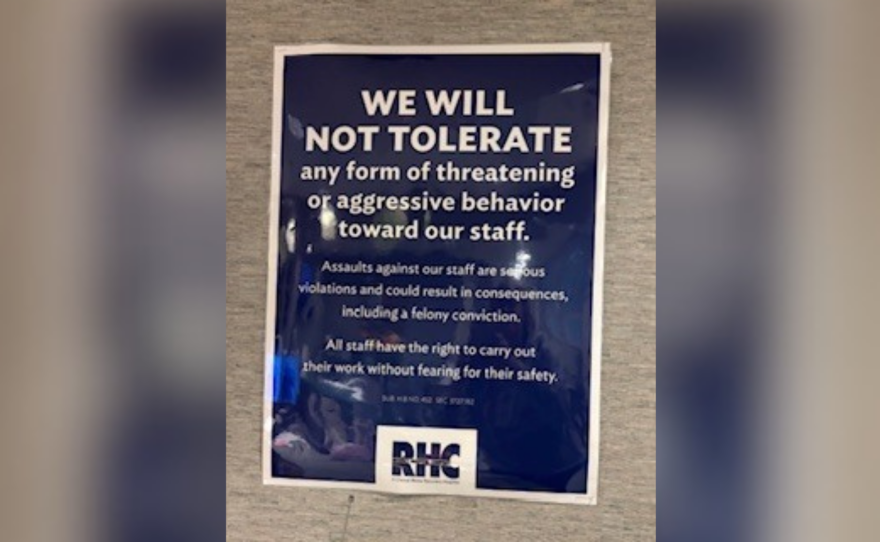


A request for comment from the corporate office at Lowe’s went unanswered, so I contacted the Vice President Alex Boehnke told me that while there are “unruly customers,� most violent incidents involve people trying to steal.
Signs warning of zero tolerance for abusive behavior are unlikely to sway criminals, but “the signage itself is just reinforcing respect for employees, respect for others, and says ‘we are going to take things seriously,’� said Boehnke.
Not every business is in the crosshairs of an organized crime ring. So, what is making consumers so agitated?
I realize that this era of uncertainty, and the fear and helplessness that come with it, could have people spoiling for a fight, often with the nearest customer service agent.
Faced with wars abroad, rising prices for groceries and gasoline and worries about the nation’s direction, I know I look for places where I can still be in control.
Beyond my apartment, where I am sovereign, and my workplace, where I know and respect my place in the organizational chart, that often leaves me trying to manage the spaces where I'm paying for a product or a service.
Armed with money, and the old belief that “the customer is always right,� I am tempted to turn self-righteously indignant when the nurse takes too long to answer a call button, a sales associate denies a refund, or — and this actually did happen — an accountant’s mistake causes the Internal Revenue Service to withdraw my income tax payment twice, which drained my bank account and resulted in a bounced check.
In each case I resisted the temptation to be snarky. My accountant wired me money to tide me over while awaiting the IRS' refund.
My friend Leslie Sekerka is a retired professor of management whose work focused on ethics in the workplace. When I told her about my interest in these anti-customer aggression signs, she gave me a 2019 article she wrote with colleague Marianne Marar Yacobian titled, “Respect as a Moral Response to Workplace Incivility.�
“When employees demonstrate respect, a deliberate decision has been made to attend to others with reflective care, acknowledging that those involved require and are due attention,� they wrote. “In this sense, respect involves choosing to yield: the supremacy of self gives way to another.�
So let’s choose to yield, even if — especially if — we think we’ve earned the right to fight.
It’s time to rethink our relationship with the oft-repeated phrase, “the customer is always right.� Because it just isn't true. When it comes to disrespectful behavior and aggressive words and body language, the customer is wrong, very wrong.
The signs are all around us.
"The Cut" is featured in ¾«¶«Ó°Òµ's weekly newsletter, The Frequency Week in Review. To get The Frequency Week in Review, The Daily Frequency or any of our newsletters, sign up on ¾«¶«Ó°Òµ's newsletter subscription page.
