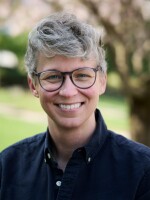
Raymond Bobgan knows that performing on stage isn鈥檛 easy.
That鈥檚 why he continuously works to provide a nurturing place for all artists to experiment and create new work at Cleveland Public Theatre.
鈥淓veryone who gets on stage, they're not getting on stage going, 鈥楲ook at me.鈥� They're getting onstage with courage,鈥� Bobgan said. 鈥淚t's that kind of courage and that kind of transformation that I think can ripple out and make things fundamentally different.鈥�
When he first discovered Cleveland Public Theatre in the early 1990s, he said he was surprised to find a place that was addressing current issues and also embracing artforms often considered outside the realm of traditional theater.
For the past 20 years as CPT鈥檚 executive artistic director, Bobgan has continued to build upon the organization鈥檚 original mission of education and advocacy while also working to secure its future through a major renovation and expansion campaign.
鈥淭his is deeply connected to community and simultaneously doing something that people presume is inaccessible. But actually it's not,鈥� Bobgan said. 鈥淚t's inaccessible to people who have gone to the theater and expect the theater to be a certain way.鈥�

An educational foundation
When James Levin founded CPT in 1981, he said the focus was on making art, not money.
鈥淚t was always about presenting plays that were maybe confrontational, that would invoke discussions about issues of the day,鈥� Levin said. 鈥淔rom the very beginning, it was about providing a stage for the voiceless, for people that otherwise would not necessarily have access to a stage.鈥�
When Bobgan first became involved with CPT, he worked with Levin on educational programming, which Levin described as the main artery between the theater and the community.
Still going strong after more than 30 years is the Student Enrichment Theatre Program (STEP), an intensive, eight-week summer program for teens that provides job training while teaching the process of creating and performing their own play.
Bobgan and Levin also worked together to launch the Y-Haven Theatre Project, a partnership with the YMCA of Greater Cleveland that teaches performing arts to community members who are unhoused or recovering from addiction. Participants create and perform an original play based on the stories of their lives.

CPT has also always been an entry place for artists to produce new works.
That tradition continues today with SoftLaunch, a weekend-long festival of in-process, non-traditional works, and Test Flight, where artists can workshop their shows in a supportive environment.
鈥淸Raymond] consistently invests resources in new work, in alternative work, and addresses the issues of the day in non-commercial theater,鈥� Levin said. 鈥淚t鈥檚 been continually transformative. What else could a founder want?鈥�

Reaching the community
A challenge arose in American theater, Bobgan said, when the regional theater movement began in the mid-20th century and professional theaters needed to differentiate themselves from amateur theaters.
鈥淪o, the amateur theaters were called community theaters, inherently meaning that if I'm a professional theater, I am not a community theater,鈥� he said. 鈥淩eally, the repercussions of that divide, we're still feeling to this day.鈥�
One of Bobgan鈥檚 top priorities has always been to reach all parts of the community.
CPT is located in the heart of the Gordon Square Arts District in Cleveland鈥檚 Detroit-Shoreway neighborhood 鈥� an area with a large Latine population. The theater is also located a few blocks from Masjid Rasool Allah, one of the first mosques established in Cleveland.
Bobgan worked with people from those populations to form two community ensembles: Teatro P煤blico de Cleveland and Masrah Cleveland Al-Arabi.
Both are a reflection of the rich cultural heritage of the city and a point of pride for Bobgan.
鈥淚t's something more organic about listening to community, sensing community, being in community,鈥� he said. 鈥淎nd there's no accident that a majority of the playwrights and directors at Cleveland Public Theatre for over 10 years are people who are Black, Indigenous and people of color. I mean, we look like Cleveland.鈥�

Continuing the mission
CPT is on its way to finishing a $12.5 million campaign to provide much needed updates and renovations to the campus along with increased visibility in the neighborhood.
The exterior facade will be enhanced with a new marquee and blade sign. A new entrance is designed to provide better access and ease of navigation to CPT鈥檚 multiple theaters.
The former St. Mary鈥檚 Orthodox Church adjacent to the theaters, which became part of CPT鈥檚 campus in 2009, will be made accessible to wheelchairs and updated to provide additional rehearsal and performance space.
鈥淭his has to happen for CPT to continue to do the work it's doing,鈥� Bobgan said. 鈥淚t is essential for the artist to feel seen, for the community to see us, to be welcoming. So much of the work we do, we're growing audiences for the entire community.鈥�